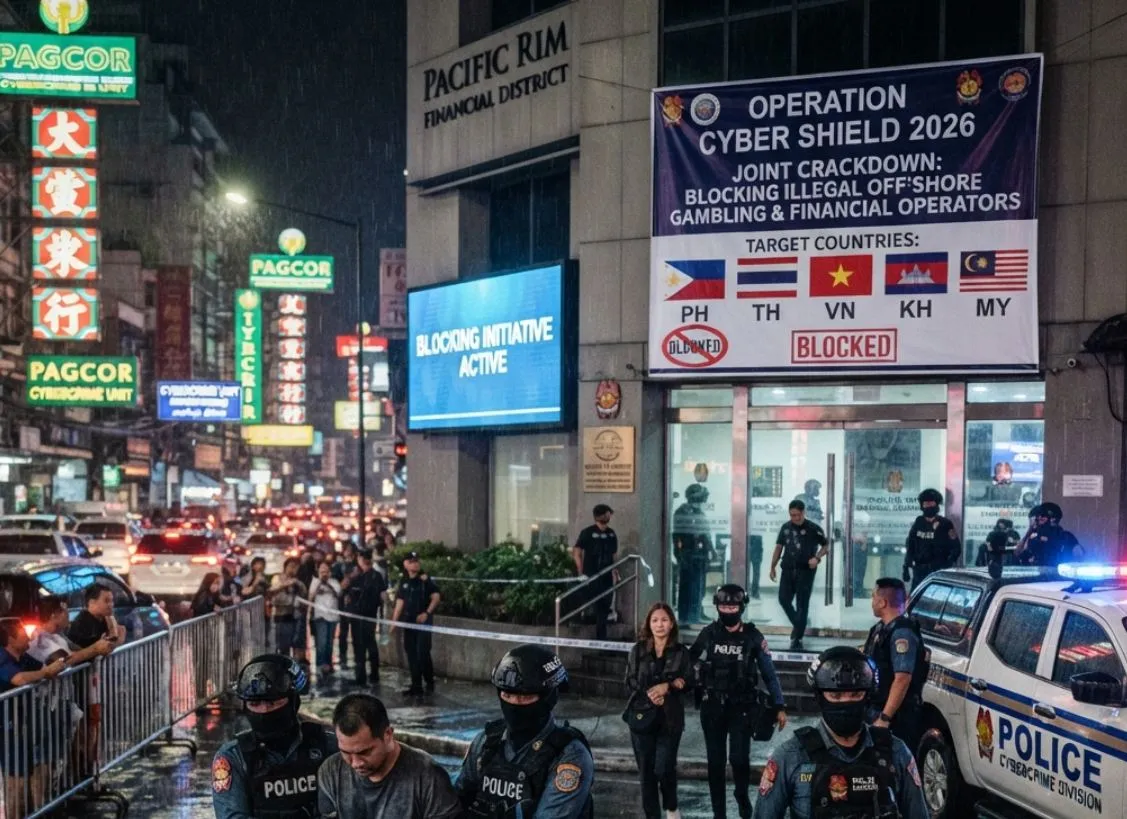
A digital wall is rising across Southeast Asia. It is not made of concrete or barbed wire but of DNS blocks, payment freezes, domain seizures, and criminal prosecutions — and it is closing in on the offshore gambling operators that have served the region for years. The grey market, that murky zone where internationally licensed but locally unauthorized operators accept bets from players in prohibited jurisdictions, is shrinking. What was once a thriving, lightly enforced ecosystem has become the target of a coordinated regional crackdown that accelerated dramatically through 2025 and now defines the regulatory landscape of 2026.
The driving forces behind this crackdown are familiar: money laundering concerns, links between offshore gambling and cybercrime syndicates, capital flight, and mounting international pressure. But the enforcement tools have evolved. Governments that once issued blanket prohibitions with no practical mechanism to enforce them now deploy AI-powered URL blocking systems, coordinate with telecom regulators to cut access at the ISP level, work with financial institutions to choke payment flows, and pursue criminal cases against operators, affiliates, and payment facilitators. The result is a fundamentally different operating environment for any offshore brand targeting Southeast Asian players.
The Philippines: from grey market hub to enforcement model
The Philippines occupied a unique position in the regional gambling ecosystem for years. Through the Philippine Offshore Gaming Operator (POGO) licensing framework, the government formally authorized operators to offer gambling services to players outside the country — a model that attracted hundreds of operators and billions in revenue but also attracted criminal syndicates that used POGO licenses as a thin legal veneer for scam operations, human trafficking, and money laundering.
In November 2024, President Ferdinand Marcos Jr. signed Executive Order No. 74, formally abolishing the POGO license regime. By the end of 2025, the shutdown was largely complete: PAGCOR, the national gaming regulator, revoked outstanding licenses, and an estimated 20,000 foreign workers — predominantly Chinese nationals — were ordered to leave the country within 60 days. The government’s enforcement task force conducted a series of high-profile raids on compounds in the Clark Freeport Zone, rescuing hundreds of trafficked workers and exposing the scale of criminality that had embedded itself within the licensed offshore sector.
The end of POGOs did not eliminate the Philippines as a gambling jurisdiction. The domestic PIGO (Philippine Inland Gaming Operator) system continues, allowing PAGCOR-licensed operators to offer online gambling to players within the Philippines. But the offshore model — the mechanism that made the Philippines a legal base for operators targeting customers across Asia — is gone. Operators that previously held POGO licenses have either relocated to jurisdictions with lighter oversight, shifted to unlicensed operations, or exited the market entirely. The Philippine shift has been described by the UN Office on Drugs and Crime as a major step that removes the thin layer of legality used by illegal operators to shield themselves from scrutiny, though the same report warns that scam centres and criminal activities will push further underground and migrate to other parts of the region.
Thailand: ISP-level blocking and the automated enforcement revolution
Thailand’s approach to offshore gambling enforcement underwent a transformation in 2025-2026 that makes it one of the most technically sophisticated grey market crackdowns in the region. While gambling remains broadly prohibited under Thai law, the enforcement gap between prohibition and practical access has historically been enormous — players could reach offshore sites with minimal friction, and operators treated Thailand as a high-value, low-risk market.
That calculation has changed. The Thai government deployed an AI-powered content blocking system known as WebD, which identifies, flags, and coordinates the blocking of illegal online gambling content in near real-time. Between October 2025 and January 2026 alone, WebD was responsible for blocking 183,977 gambling-related URLs, representing nearly 83% of all illegal content blocked during that window. The system operates by continuously scanning for gambling content, matching it against regulatory databases, and automatically issuing blocking orders to ISPs — reducing the time between detection and enforcement from weeks to hours.
Thailand has also moved to address the payment dimension of the grey market. Traditional banking networks in Thailand actively block gambling-categorised transactions, and the government has coordinated with major e-wallet providers to close accounts associated with offshore operators. The proposed 2026 amendments to Thailand’s gambling legislation include significantly harsher penalties: up to three years imprisonment for players and seven to twelve years for organizers. The country is also exploring the possibility of a regulated domestic online gambling framework, which would represent a dramatic policy shift from total prohibition to controlled licensing — though no such framework has been enacted as of mid-2026.
Japan: the new entrant in offshore enforcement
Japan’s engagement with offshore gambling enforcement represents one of the most significant developments of 2025-2026. Historically, Japan prohibited gambling but had limited practical enforcement against offshore operators serving Japanese residents. That posture changed with the passage of the Basic Act on Countermeasures Against Gambling Addiction in June 2025, which explicitly prohibits any person from presenting websites or programs for illegal online gambling to Japanese residents and from transmitting information that directs Japanese residents to illegal gambling.
The Act’s language is broad enough to apply to offshore operators, not just domestic ones, and the Japanese government has signalled its intention to pressure foreign governments that license offshore casino sites to implement geo-blocking against Japanese users. Enforcement of offshore site removal began in September 2025, and while Japan lacks a statutory ISP-level blocking mechanism — a known enforcement limitation — the government has been using alternative legal routes, including criminal prosecution of domestic affiliates, payment processors, and marketers who facilitate access to offshore sites.
Japan’s enforcement strategy is distinct from Southeast Asia’s more aggressive blocking models. Rather than building technical infrastructure to cut access at the network level, Japan is pursuing a liability-based approach: making it legally dangerous for operators, affiliates, and payment facilitators to serve the Japanese market, even if the operators themselves are based abroad and beyond direct Japanese jurisdiction. The practical effect is that some operators have implemented voluntary geo-blocking for Japanese IPs, not because they are legally required to but because the risk of prosecution for their local affiliates and payment partners has become too high.
The enforcement toolkit: how countries are actually blocking offshore operators
The methods used to restrict offshore gambling access have diversified significantly. No single technique is sufficient on its own, and the most effective enforcement strategies combine multiple approaches that target different points in the chain between the operator and the player.
Each enforcement method targets a specific vulnerability in the offshore operator’s delivery chain, and the most effective national strategies layer several of them simultaneously.
| Enforcement method | Target | Country examples | Effectiveness | Operator countermeasure |
|---|---|---|---|---|
| ISP-level URL blocking | Access | Thailand, Indonesia, Malaysia | High for casual users; bypassable via VPN | Domain rotation, mirror sites |
| DNS blocking | Access | Philippines, Vietnam | Moderate; tech-savvy users bypass | Alternative DNS, encrypted DNS |
| Payment channel blocking | Funding | Thailand, Malaysia, Philippines | High; directly cuts revenue | Crypto (USDT), e-wallets, underground banking |
| Domain seizure | Infrastructure | US-led, regional cooperation | High but temporary; operators migrate | New TLDs, non-.com domains |
| Criminal prosecution of affiliates | Promotion | Japan, Malaysia, Thailand | High; reduces local marketing | Offshore affiliate networks |
| App store removal | Mobile access | Regional, coordinated with Apple/Google | Moderate; sideloading bypasses | Web apps, direct APK distribution |
| Geo-blocking requirements | Operator policy | Japan, South Korea | High for compliant operators; irrelevant for non-compliant | Non-compliant operators ignore |
The picture that emerges from this layering is one of escalating friction. No single measure eliminates access, but the cumulative effect of blocking URLs, choking payments, seizing domains, prosecuting affiliates, and pressuring app stores is that the cost of serving a grey market rises steadily. Operators that once faced near-zero enforcement risk now must invest in domain rotation infrastructure, crypto payment rails, offshore affiliate networks, and alternative app distribution channels — costs that squeeze margins and push smaller operators out of the market.
What the crackdown means for players in the region
The enforcement surge is not just an operator-side story. Players in Southeast Asia are directly affected by the changes, and the impact varies depending on the country, the enforcement intensity, and the player’s technical sophistication.
For casual players who access offshore sites through standard web browsers and local payment methods, the crackdown is effectively a wall. URL blocking and payment restrictions make it significantly harder to reach sites and fund accounts. A player in Thailand who once deposited via a local bank transfer now finds that the transaction is flagged and refused. A player in Malaysia who clicks a gambling link finds that the site does not load. The result is not that these players stop gambling — many find alternative routes — but that the path from interest to access becomes longer and more uncertain.
For more technically literate players, VPNs and crypto payments provide a reliable workaround. The enforcement toolkit is designed for scale, not precision: it blocks the majority of casual access but cannot fully prevent determined users from reaching offshore sites. The shift toward crypto — particularly USDT on TRC-20 — as the dominant payment method for grey market gambling in Southeast Asia is a direct response to payment blocking. Where traditional banking rails are closed, stablecoins fill the gap, and the decentralized nature of crypto wallets means that no central authority can freeze them without the wallet holder’s private keys.
The practical consequences for players extend beyond access. In jurisdictions where offshore gambling is prohibited, players have no domestic legal recourse if an operator refuses a withdrawal, misapplies bonus terms, or disappears with deposited funds. The international license the platform holds — whether from Curaçao, Anjouan, Malta, or elsewhere — may offer a complaint mechanism through that regulator, but enforcement of any judgment against an overseas operator is realistically limited. The grey market’s growth has always depended on a tacit social contract: operators provide access and honour withdrawals, players accept the legal ambiguity. As enforcement tightens and operators face higher costs, the financial pressure on that contract increases, and the risk of operator insolvency or outright fraud rises.
The displacement effect: where operators are moving
One of the most consistent patterns in gambling enforcement is that pressure in one jurisdiction displaces activity to another. The Philippines crackdown did not eliminate the offshore gambling operators it targeted — it moved them. The UNODC has documented a clear displacement pattern: as enforcement intensified in the Philippines and Cambodia, operations shifted to Laos, Myanmar, and other parts of the region with weaker governance and limited enforcement capacity.
Myanmar has emerged as a primary destination for displaced operations, particularly in the border regions and special economic zones where central government authority is limited. The country’s political instability since 2021 has created an environment where enforcement against offshore gambling is effectively nonexistent, and organised crime syndicates have established large-scale scam and gambling compounds that operate with impunity. Cambodia has experienced a similar dynamic, with periodic crackdowns followed by resurgences of activity in Sihanoukville and Phnom Penh.
The regional enforcement picture is therefore one of pressure and displacement rather than elimination. Each country that tightens its enforcement pushes operators toward neighbours with weaker controls, creating a regulatory arbitrage dynamic that mirrors what has occurred in other regulated industries.
How operators are adapting to survive the 2026 crackdown
Offshore operators are not passive participants in this regulatory shift. The brands that continue to serve Southeast Asian grey markets in 2026 have adapted their operations, technology, and business models to survive in an environment where enforcement is active, automated, and escalating. Understanding these adaptations is essential for grasping the full picture of the grey market crackdown, because the operator response shapes the next phase of the cat-and-mouse dynamic between regulators and platforms.
The adaptations fall into several categories, each addressing a specific enforcement pressure point.
- Domain rotation and mirror site networks — operators maintain dozens or hundreds of alternative domains, automatically redirecting players when a primary domain is blocked. The cost of domain registration is trivial compared to the revenue at stake, and new generic top-level domains provide an effectively endless supply of alternatives.
- Crypto-native payment architecture — with traditional payment channels blocked, operators have integrated USDT and other stablecoins as primary deposit and withdrawal methods. Multi-chain wallet support, instant settlement, and QR-code-based deposit flows replace bank transfers and card payments.
- Telegram and encrypted messaging for affiliate distribution — as public advertising channels are restricted and social media platforms enforce gambling ad bans, operators and their affiliates have migrated to Telegram, where gambling promotions, bonus codes, and direct registration links can be distributed to private channels with minimal platform oversight.
- Progressive web apps replacing native apps — app store removals are a growing enforcement tool, but progressive web apps that run in a browser and can be installed on a phone’s home screen without going through Apple or Google’s stores provide a resilient alternative that is harder to block.
- Localised payment integration despite restrictions — operators work with local e-wallet aggregators and underground banking networks to maintain payment access in specific markets. GCash in the Philippines, MoMo in Vietnam, and TrueMoney in Thailand are all targeted by regulators, but the sheer volume of transactions makes complete interdiction difficult.
- Geo-blocking as a compliance strategy for premium operators — some operators, particularly those holding MGA or UKGC licenses alongside their grey market activities, implement geo-blocking for jurisdictions where enforcement is most aggressive. This sacrifices revenue in high-risk markets but protects the operator’s primary license from regulatory pressure.
The operators that thrive in the 2026 grey market are not the largest or the most visible — those are the ones most likely to be targeted. The survivors are the most agile: small enough to avoid regulatory attention, technologically sophisticated enough to rotate infrastructure quickly, and diversified enough across markets that losing access to one country does not threaten the business.
The road ahead: what the 2026 crackdown signals for the future
The grey market crackdown in Southeast Asia is not a temporary enforcement campaign that will ease when political pressure subsides. It reflects a structural shift in how governments across the region view offshore gambling — from a tolerated nuisance to a national security concern linked to money laundering, cybercrime, and human trafficking. The infrastructure built to enforce these crackdowns — AI-powered blocking systems, payment monitoring networks, cross-border cooperation agreements — is permanent and will only become more sophisticated.
The most likely trajectory for the region is a split between regulated domestic markets and an increasingly hostile environment for offshore operators. The Philippines has already made this split explicit: domestic online gambling through PIGO is legal and regulated, while offshore gambling through POGO is abolished. Thailand appears to be moving in a similar direction, with serious legislative discussion about creating a domestic online gambling framework. Vietnam continues its cautious liberalisation, with pilot programmes allowing local access to certain land-based casinos and sports betting under strict conditions. If these domestic frameworks succeed in capturing a portion of the demand currently served by the grey market, the rationale for offshore operators weakens further.
For operators, the message of 2026 is that the grey market window in Southeast Asia is narrowing. The era of cheap access, minimal enforcement risk, and passive regulatory tolerance is closing. The brands that survive will be those that invest in compliance where regulated pathways exist, build resilient infrastructure where they do not, and make hard decisions about which markets to serve and which to abandon before the enforcement costs exceed the revenue. For players, the crackdown means reduced access, higher friction, and greater risk — the protection of a regulated domestic market, where it exists, is becoming the only reliable guarantee of a safe gambling experience.
The wall is not finished. But it is high enough now that anyone operating on the grey market side can see it clearly — and the countries building it show no sign of stopping.